Ichi school’s two-sword method
The Book of Five RingsIchi school’s two-sword method is the practical and strategic principle behind fighting with a long sword and companion sword, but its significance reaches beyond using two weapons at once. It links adaptable weapon handling to a trained body, a broad field of attention, and a strategy meant to prevail in both individual combat and large-scale war.
Principle and Purpose
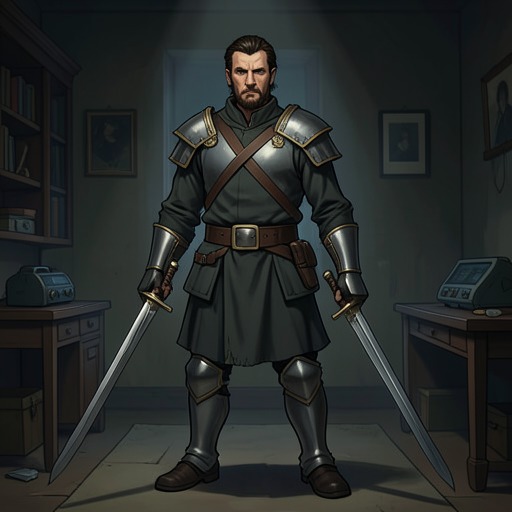
The method is introduced as the meaning of Ichi Ryu Ni To: one school, two swords. Because warriors carry two swords at the belt, the school treats their paired use as a discipline to be learned rather than as a mere feature of equipment. Students are directed to train from the beginning with a sword in either hand and to make full use of their weapons when their lives are at stake. To die with a weapon still undrawn is presented as a failure to use the means available.
The method belongs to a larger account of strategy, which the book organizes into five books: Ground, Water, Fire, Wind, and Void. The Water book explains the principles of the Ichi school, using water’s capacity to take the shape of its receptacle as an image of adaptable practice. The method’s underlying ambition is likewise expansive: learning to defeat one opponent should develop into the ability to understand how victory over many may be achieved.
This practical emphasis distinguishes the school’s idea of strategy from the narrow cultivation of dexterity. The aim is not merely to collect sword movements, but to learn how to overcome opponents in conditions where life and death are at stake. The text extends that ambition from one fighter facing several adversaries to the broader principle of understanding an enemy’s strength and resources well enough to apply strategy at the scale of thousands.
Handling Weapons and Adapting to Conditions
The method rejects holding the long sword in both hands as an absolute rule. A two-handed grip restricts free movement to the left and right, while a one-handed grip leaves the other hand available for another weapon or task. The text names concrete conditions in which that freedom matters: horseback, uneven roads, swamps, muddy rice fields, stony ground, and crowds. It also recognizes an exception: when a single hand cannot bring down the enemy, both hands should be used. Adaptation, not an unchanging grip, governs the choice.
Training with two long swords, one in each hand, is offered as a way to overcome the initial difficulty of wielding a sword with one hand. The text compares this learning curve to drawing a bow or handling a halberd: what first feels difficult becomes effective through practice. Weapon use is differentiated rather than uniform: the long sword should be wielded broadly, while the companion sword is used closely. The school’s principle is not that one weapon or size always wins, but that victory can be sought with either a long or short weapon according to the situation.
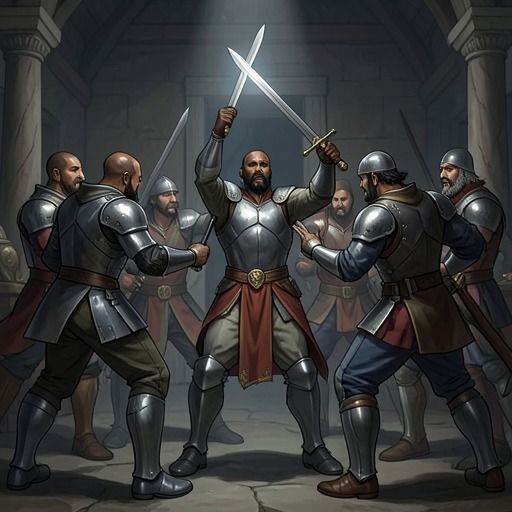
The paired weapons have particular value against a crowd, especially when the aim is to take a prisoner. This is one of the clearest tactical consequences of the method: the second sword is not simply a symbol of the school but an additional means of acting in a fight involving multiple opponents or a specific objective beyond defeating them.
The Trained Body and Field of Attention
The teaching extends from weapon choice to the body that wields the weapons. The prescribed stance keeps the head erect, the face composed, the neck straight, and the shoulders lowered. Strength is carried through the legs, the abdomen is braced, and the companion sword is wedged into the belt against the abdomen so the belt does not slacken. The body is trained as an integrated fighting posture rather than as a collection of isolated movements.
That combat stance is also to be maintained in ordinary life: everyday posture should become combat posture. The instruction makes the boundary between practice and action deliberately permeable. Readiness is not reserved for the moment a fight begins; it is cultivated as a consistent bodily habit.
The gaze must be broad, combining perception with sight. The practitioner is instructed to see distant things as though close and close things from a distance, and to recognize the enemy’s sword without being distracted by insignificant movements. The same gaze applies to a duel and to large-scale strategy. Looking to both sides without moving the eyeballs is another skill to develop, and the text says it cannot be mastered quickly. Attention, like weapon handling, must be trained until it remains steady in everyday life and under changing conditions.
The grip likewise joins firmness with responsiveness. The thumb and forefinger hold the long sword with a relatively floating feeling, the middle finger is neither tight nor slack, and the last two fingers grip firmly; there should be no play in the hands. Yet the grip must not become fixed. The hands remain intent on cutting, with a slight adjustment in thumb and forefinger when dashing aside, warding off, or forcing down an enemy’s sword. A rigid hand is described as dead, while pliability makes it living. The method’s discipline is therefore not stiffness but controlled readiness to change.
Footwork follows the same logic. The toes remain somewhat floating while the heels tread firmly, and movement should resemble ordinary walking whether the steps are fast or slow, large or small. The text rejects jumping-foot, floating-foot, and fixed-steps. Instead, it prescribes Yin-Yang foot: the practitioner must not rely on moving only one foot, but shift left and right, and right and left, when cutting, withdrawing, or warding off a cut.
Contact, Timing, and Strategic Reach
At close quarters, the method’s bodily principles become direct techniques. Glue and Lacquer Emulsion Body means sticking to the opponent rather than separating: head, body, and legs must approach together so that no gap opens between the two bodies. The instruction addresses a common failure in movement, where the head and legs advance but the body lags behind. Maintaining contact closes that gap and makes the whole body part of the action.
The Body Strike turns this close approach into an attack. The practitioner enters through an opening in the enemy’s guard, turns the face slightly aside, and drives the left shoulder into the enemy’s breast. The strike is to be timed with the breath and delivered with the intention of bouncing the opponent away. The text gives a concrete measure of its possible force, saying that a successful strike may knock an enemy ten or twenty feet away, and may be continued until he is dead. The technique makes bodily entry, timing, and force inseparable.
At the larger level, the same responsiveness requires reading the enemy’s condition. To know the times means judging whether the enemy’s spirit is flourishing or waning, observing the men’s disposition, finding the best position, and moving one’s own men accordingly. In a duel, the fighter first recognizes the opponent’s school, quality, and strengths and weaknesses, then attacks unexpectedly at the appropriate rhythm. The two-sword method thus belongs to a strategy of perception: weapons are used effectively only when the practitioner can read circumstances and act at the right moment.
Teaching and Strategic Significance
The method’s demanding principles are presented as learnable through practice, not as a gift reserved for the naturally talented. The warrior’s Way is described as resolute acceptance of death, while strategy itself is defined by overcoming opponents, whether through individual contests or battles involving large numbers. The paired swords give that Way a concrete bodily form, but the intended knowledge is broader than the motions of either hand.
The teaching also insists on sustained research and training. The book presents its five-part structure as an outline of distinct aspects of the Way, and warns that sword-fencing alone does not make the whole strategy understood. Its claim is that a fighter can train individually with a sword and thereby learn to judge an enemy’s strategy, strength, and resources, extending practical understanding toward encounters on a much larger scale.
The Wind Book places the Ichi school among other traditions, including schools that specialize in extra-long swords, short swords, or extensive systems of techniques and attitudes. The account deliberately avoids naming those schools or fixing their doctrines, because different branches interpret teachings differently and no single person’s conception represents an entire school. Against systems organized around a gate, an interior, or a fixed set of sword attitudes, the Ichi school claims no such inner division: its spirit must remain true to realize strategy’s virtue. The two-sword method is therefore not a rigid formula for always wielding both weapons in the same way. It is a discipline of trained adaptability, joining concrete bodily technique to the larger work of reading and overcoming the opponent.